

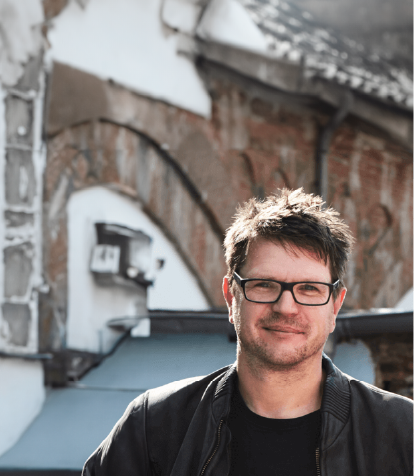
In this enlightening conversation with Mario Husten, the visionary founder of Holzmarkt, we delve into the vibrant subcultural landscape of Belgrade. Husten shares his insights on how the city’s unique blend of history and creativity fosters an environment ripe for innovation and artistic expression. This interview explores Husten’s belief that true cultural value transcends financial metrics, emphasizing the importance of adaptability and collective ingenuity in shaping a thriving community. Join us as we uncover the transformative power of culture in Belgrade and beyond.
So, Mario, you say you see a lot of (cultural) potential in Belgrade. Many of us involved in it at any extent see that as a bit of a shocker. How do you recognize it?
The format that we founded more than 10 years ago is an association of some of the subcultural entrepreneurs and activists in Berlin, the “Berlin Works”. We had Dimitri Hegeman, the owner of “Trezor”, the legend of subcultural life. We started actually with Detroit due to the electronic music. We had Thessaloniki because the mayor came to Berlin and asked what I do to enable and encourage the culture in my city as a mayor. The only thing we could tell him was to send him over to Berlin and then we are coming there. You need a subcultural exchange for development! This is the name of our format, it’s called the potential. I think if you look at Berlin, Berlin is now changing again. There are different phases of subculture development in the city and it’s not due to gentrification but the opposite because after Corona, the habits and the culture have changed. So the club, the habits for clubbing have changed. Many clubs are closing, not because of gentrification, but because of the change of the business and their behavior. I think Belgrade has changed a lot as well. It got gentrified. So this massive investment into the Belgrade waterfront is… woo! I don’t want to comment on this. It’s not on me, but… I’m not the person to blame someone. It was an attempt to give the city a push and to develop and to make, you know, a kind of master plan to develop, to open the city to the river. It was not sensitive, organic, or a kind of user-driven development. It was investor-driven. So, anyhow, they face problems and they see now what are the limits and the borders of these kinds of developments. For me, it’s obvious that this is a huge investment that will face soon the problems of property development. But the window of opportunity for Belgrade is that there is a lot of focus and this is not a huge success commercially, it’s not a huge success from the urban development, it’s questionable, and it’s controversial, but there is now the focus on the Expo, so they all turn to the fair. There is a huge potential in other districts and when we started Dorćol Platz together with our friends from Belgrade, it was clear in the discussion, and I had discussions with Ivan (Lalić), and said, yeah, we have to fight. Yeah, but it’s better to fight for something than against something. Because Savamala is demolished you have no chance to rebuild it, but you can show that you have a better option. This was our idea for establishing and opening Dorćol Platz.
Is this potential physical, the infrastructure potential, or the people capacity, the spirit potential?
I will come to this. This is just the headline of what we are doing. We are not exporting a model so Berlin knows what the recipe for subcultures is, but we have a certain approach. When we went first to Detroit and we had the work there, we just got a letter today from the mayor of Detroit asking whether we can come back. After 10 years he wants to develop a subcultural district, a pocket plant, the largest industrial site in the world, with Motown and the underground labels there in Detroit. Coming back to Belgrade, I never had a reason 15, 10 years ago to walk down to Dorćol – for what? There was nothing. So, it’s down the hill, but you have to climb up again, so rather stay where life is. So when I came for the first time here in 2010, when my friend, Veso from Blic (Veselin Simonović), opened the first integrated digital newsroom here, in an industrial site, I said, wow, cool, you have a lot of space. Then we spotted this courtyard there, this old Minel courtyard. There’s a potential in this place. Because you have a gated, open-air space, you have some buildings, you have some infrastructure. In Berlin, we exploited a factory or we rented temporarily a space and then we moved on. So we went to another building. So this is the strength of subcultures, improvisation, not relying on investment but engagement.
Mario:
Clubbing habits have changed.
So that’s why I told him, hey, give it a try and offer an alternative and try to gain the potential: space, people, competence, and audience. Why I see potential in Belgrade, there are mainly three reasons. There is a lot of potential in Belgrade since the focus of the politics and the investors is now on a major development. So Belgrade waterfront is not sold out, it’s not a huge success, has some problems. The priority of the politics is now on Expo 2027. So of course there are developments here, but there are many different layers, and spaces. You know, if you take Silosi and Hangar on the property of a private investor, you have a museum and a community center as community-based projects. You have huge industrial sites. What is obvious is that this is a potential area for civic development, for community development. This is the result of the former decades that you have to split residential and industrial areas. This is not the case anymore. I think that we identified a lot of space here in Dorćol to develop. There are actors who are improving the concept. But most importantly, there is a huge migration of talented, educated, and capable people from Russia. But they take care of the city, they want to give it a push and this is what you see in Upper Dorćol. Of course, it’s a kind of gentrification too, but this has the potential to bring Belgrade to another level of cultural exchange. That’s why we think that cooperation on this level is the only way to come up with alternative developments. So I was working in Budapest and Bucharest, and I didn’t see that potential in those cities. Belgrade has an extraordinary location, two rivers, and one river bank that is not developed at all. So there are all these plans we are aware of, but there are no concepts, there is no content. So what you see, is that the government tries desperately now at Waterfront to bring culture to this place. Look at the “Ložionica” space! Wow! It is really great! But this is not how culture works. So nevertheless you have to talk to them.
What about the scene? What about the people that you bring the energy into the places? What do you see that way?
It depends on the generation. There is a huge drain of talent and creativity over the past 10-15 years. But as I said, the migration, the young people knowing, hey, come on, I have to live here, I have to be, I want to get involved. If you rent a space to watch Serbian movies with Russian subtitles because you want to learn the language, you want to integrate, they take care about the neighborhood, they are doing surveys on a level that was so far unknown here because nobody was paying for this, this is a civic engagement. This can encourage the people, hey come on, the different view is important, the different perspective is important, the international partnership is important. You have to do it yourself, you have to be self-responsible for this. We have to bring people together. I don’t believe in the potential of citizens, you know, who were born in Belgrade, who can lift the culture. No one, because all the people I know who might have been capable, they went somewhere. Yesterday I met a friend from New York, he came back and said, yeah, we want to bring something back. And they are not aware of the development here. They are not aware of the potential. Because they always see the problem…
Mario:
The Belgrade Waterfront was not sensitive, organic, or user-driven development. It was investor-driven.
I can tell you the vision for Lower Dorćol and this is what we can bring in as international partners, to start from a broad perspective. This is what you can learn from the politics. Remember Henry Kissinger: he went to Shanghai just to sign a document with all the points they did not agree on, and start talking about it. This is what we are trying to do here.
You mentioned narrative and storytelling before…
You need it. To make the people aware here that there is a movement. You have places like Cetinjska with a lot of different content but a community was never formed there. Just a nice place, but no curation, cooperation, just everything random. Savamala was unique that was but it was organically grown with historical background. And Belgrade is not too big, you know, every musician has already played with almost everyone else, dated each others’ girlfriends, and know whom they can or can’t work with. Let me tell you, it is not even about whether you’ll succeed, if you see the potential, have fun with it, be courageous, and if you lose, no one can say you haven’t tried.
Who would be your first actors? If you were to do something about it tomorrow, who would you call?
I would take a shuffle. So I’d like to call someone. First of all, you don’t call someone, you walk around. So you see… So if I see in front of Pržionica sitting 20 people drinking coffee on the street… But there is no one drinking coffee. What is the reason therefore? I would knock on the door of the neighbor. Who are you? I would look where is the next tree with a bench. I would look where is the next bakery. Where is the next shopping facility? Why I can’t go to Dorćol Platz? You shouldn’t be hungry if you go there because what if there is nothing to eat?
You should bring your friends. Because you are not sure that you have company there. You need to have all these reasons to get there.
This is how we can map the challenges and the potential…
Last year, we made significant investments in a cultural program aimed at enhancing community engagement and proving that people are willing to attend events. The location we selected is superior to other sites along the Danube, despite the logistical challenges it presents. For instance, reaching Silosi requires a bike or car, and traveling to Hangar during inclement weather can be cumbersome.
While some locations, like Gastrošor, may seem isolated—described as a “random Disneyland”—they at least offer parking facilities. This underscores the necessity for those involved in cultural initiatives to embrace the effort required to engage with the community. It’s important to be open-minded and proactive, particularly when considering the infusion of diverse cultural elements, such as those from Russian subcultures.
Mario:
It’s better to fight for something than against something.
What cultural dynamics and community engagement tips and tricks have you spotted, and learned on the go?
There is a prevailing mentality that relies on government or city solutions for societal issues. When new groups, like Russian immigrants, arrive, they often face skepticism regarding their intentions. It’s crucial for all stakeholders to find common ground and discuss their objectives openly. Recently, two urban festivals organized by Russian activists and planners have taken place, showcasing not just events but also recognizing existing spaces as valuable assets. Belgrade lacks many open-air venues, making it essential to utilize available spaces creatively.
We focus on understanding the neighborhood dynamics and the narrative behind our presence in a particular area. The local community offers excellent coffee and bread and includes a community center equipped with sound studios. Historically, marketplaces served as central gathering points in villages. We aim to recreate this sense of community by integrating various cultural infrastructures and green spaces into our projects.
Mario:
There is a huge drain of talent and creativity over the past 10-15 years.
We analyze existing conditions—cultural infrastructure, green spaces, and development dynamics—to identify what has been established over the last two decades and what potential developments lie ahead. This comprehensive analysis allows us to propose specific scenarios for urban interventions. For example, transforming a parking lot into an urban plaza could create a vibrant marketplace where people can choose between various cultural activities like cinema or theater performances. Our proposals emphasize family-friendly environments that are also environmentally sustainable.
Sounds effortless, until we remember our own exhaustion by the daily politics…
Despite the challenges posed by the current political climate in Belgrade and Serbia, we remain committed to our vision. The key is not to fear potential setbacks but to advocate for positive alternatives. Engaging with neighbors and stakeholders is vital; we must not resign ourselves to defeat simply because of external pressures. The experience from Berlin illustrates that with a solid concept and business model, it’s possible to create valuable public spaces that attract investment while serving community needs. This approach has led to successful initiatives like kindergartens, theaters, and public parks.
Ultimately, fostering dialogue among community members is essential for overcoming fears related to survival and stability. Many individuals feel exhausted or apprehensive about their futures, especially outside major cities like Belgrade. However, by encouraging collaboration and offering viable alternatives, we can empower communities to take an active role in shaping their environments. In conclusion, it’s crucial for us to engage with investors and politicians without necessarily agreeing with them. Instead, we can present our vision for community development and work towards creating spaces that benefit everyone involved.
It has to tell the right story to the right ear?
You create a new urban community district. Because if you look with open eyes, and walk through, they have lost the context of the community. There are all the fancy bars and the people are meeting there. The bars are full. But there is no vibe. So I miss the vibe that was there 20 years ago.
At least in my memories. What I mean, you first change your wording, like competition. It’s cooperation.
Cooperation is in the word, you can spell it, it’s literally like this. You co-operate.
When we opened our place, we had a lot of applications. All the people wanted to rent that space there. Mostly yoga teachers. So, okay, how many hours per day you can teach yoga? How many days per week and how many weeks per year? Do you think that you want to rent exclusively a yoga room?
Mario:
Let me tell you, it is not even about whether you’ll succeed, if you see the potential, have fun with it, be courageous, and if you lose, no one can say you haven’t tried.
Or you want to do it with someone else? Then you can put a hundred applications together and you can wait. Who’s left?
The one who can cooperate. Oh, we are not used to it. But look at Dereta, they are doing it. Dorćol Platz, they try to do it. So this is a different setup and a different mindset. Something different happens every day. Today it’s backstage, tomorrow it’s a seminar room. And in the morning it’s a playground. Then you build differently.
You don’t build special purpose, but multipurpose, flexible. We have modular elements. We saw our plans here.
All this is modular and flexible. So we can have this there and there and there. You don’t have to store all this stuff.
So a massive deconstructing of Serbian and Belgrade mindsets has to take place?
It has to change the currency. It is not always money, it is improvisation and resourcefulness. We borrow, exchange, give, and take in kind… And this is the way of making things happen. This is what you can learn from subculture, improvisation. Then you can try and it’s not that costly if you fail. Because you don’t have to invest a lot.
Why do we always feel we have to fight against something for something so essential?
No, this is the feeling you allow yourself.
So I have had many discussions with Ivan (Lalić)… Because what we are doing is enabling and encouraging. Nothing else. So we don’t teach, we don’t train. We just say, look, you can do it. And if you start with one table or two tables and this, then it works.
Your expectation is not the expectation of someone else. Someone looks for a quiet place. Someone is looking for a nice party.
Talk openly. But if you confront everyone with your experience, good or bad, it’s horrible. I’m a grandfather. What shall I tell to my kids? Don’t do this because I did it 40 years ago.
The Mikser is standing strong though, after the Savamala and all…
I love the title of the previous festival! Microtactics. And this is exactly what I believe in. Yugoslavia was a place where it was a huge social experiment. Self-responsible. Self-organizational structures. It failed, as we know. But not due to the system. But it allowed people to breach the rules. To overtake this. The smartest and the cleverest or the most brutal.
Someone tried to breach into the community you have set up in Berlin. How did you “defend” it?
You have to set certain priorities and conditions. To say, hey, come on. If we get hold of a piece of land or building that doesn’t belong to someone. It’s off the market. So you just have to breach the rules. What we did is we convinced the Swiss Pension Fund. Say, hey, come on. You want to invest some money. You want to have a return on invested capital. But you don’t want to speculate with land. So that’s why let’s make a different deal.
So this is what we teach in the academy. Teaching is a wrong word. We try to change the perspective. You have to know what your potential opponent or adversary is thinking. And then you have to use it.
Transparency. So they cannot say, oh, you’re hiding. You simply don’t play their games. Okay, let’s stand in the middle and tell everyone. We publish all our documents. No problem.
Nobody can say, I didn’t know. What is wrong? If somebody steals it, it’s open source. So what?!
He can only make it better or worse. But then you have proof.
How do you imagine the best-case scenario for Belgrade that way?
But when could you or anyone of us expect to see something like that happening? I know it’s happening right now. And I know it’s been happening.
But something in a way tangible. Something that makes people feel welcome and safe. And actually cheerful in their neighborhood.
I was at the university with freedom fighters. I actually remember the day when Nelson Mandela was released from prison after 27 years. What did he say? What? Revenge? Or forgiveness? So the point is, I have many friends in Russia. I have many friends in Ukraine. I have many friends in Palestine. I have many friends in Israel.
And for our place, there is no national flag. Weapons down. And you can talk. You don’t have to agree. But you cannot attack someone else.
If we tried to wrap this up, how would we define this notion, should culture, and the future be modular, and flexible..?
Unideological. So you need to talk to someone that you know that he disagrees with you.
It’s very important. This is the most challenging thing. And to find a common ground.
What do we agree upon? What is the common ground we are standing on? You live with all those people who elected this president. In the same city. And if you don’t go try to talk to them, you are not responsible for your city. This is why I will go to Ložionica and see who the people there, try to experience it. If you say you want an open society, you have to respect the other’s opinion. That’s why I always start with seeing the good side. So, Ložionica is a great venue, fully equipped. But think about your reasons for going there, and who is already there and why.
Mario:
If someone steals your idea, it’s open source. So what?! He can only make it better or worse. But then you have a proof.
You know, being a director of such a place, imagine they provide space and accept the alternative culture. O-ho! It would be a shitstorm! So be it! Go through! That’s the only way of giving a different view on subculture. Otherwise, you push polarization. We need to make offers for culture, all participants, not just “members” of a particular “club”, invite especially those who disagree. Like your elections! Everyone who comes to me and says, I am against the government, I ask whether they have boycotted the elections. Or have they voted? The way I see it, this is not the victory of the government but the defeat of the opposition!